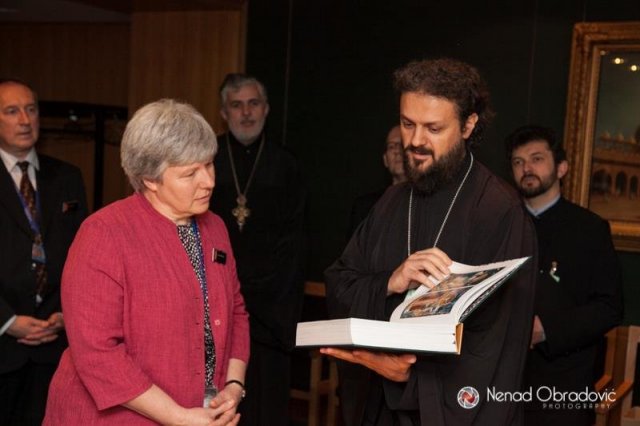
On 11 May 2015 a delegation led by His Grace Bishop Maxim, of the Western American diocese, and His Excellency Dr Ognjen Pribicevic, Ambassador of the Republic of Serbia to the United Kingdom, visited the British Library (The British Library, 96 Euston Road, London NW1 2DB) and presented a copy of the monograph 'The Christian Heritage of Kosovo and Metohija: the Historical and Spiritual Heartland of the Serbian People' (an expanded edition of the book 'The Endowments of Kosovo – Monuments and Testimonies of the Serbian people', published in Serbian in 1987). The British Library is the national library of the United Kingdom and it houses the most valuable manuscripts, printed and digital books and materials in all formats in all languages. Many of the most valuable books and manuscripts, periodicals, patents, maps and drawings are kept here. For this reason the British Library is regarded as one of the most prestigious cultural institutions in the world.
The high level delegation, with His Grace Bishop Maxim and His Excellency Ambassador Dr Pribicevic, included HRH Princess Katarina Karadjordjevic; Father Sava, Abbot of the Decani Monastery (in Kosovo and Metohija); Father Dimitrije, Hieromonk of Decani Monastery; Mr Sava Pejic, former curator in the British Library; Mr Petar Agbaba, President of the London Parish Church Council; Father Goran Spaic and Father Dragan Lazic, London parish priests. The delegation was met by Mr Milan Grba, Curator of the South Eastern European Studies, who with his colleagues arranged a tour of the Library and an exhibition of some of the most valuable Serbian books kept in the British Library.
.The display of manuscripts and books included:
- The Gospels of Miroslav (Miroslavljevo jevanđelje), King Alexandar Obrenović edition, Vienna 1897
- The Gospels of Metropolitan James of Serrhae (Cetverojevanđelje Jakova Serskog mid-14th century
- Saint Basil's writings on the ascetic life (Spisi Svetog Vasilija o monaškom životu) mid-14th century
- Pontifical of Metropolitan Visarion, (Činovnik mitropolita dabarskog i cele Bosne Visariona) Žitomislić Monastery 1706
- Octoechos (Oktoih prvoglasnik) Cetinje 1494
- Festal Menaion (Minej praznični Božidara Vukovića) Venice 1538
- Psalter (Psaltir Đinamijev) Venice 1638
- The art of wine making (Iskusni podrumar) Vienna 1783
- The Life and Times of Dositej Obradović (Život i priključenija) Leipzig 1783
- Serbian dictionary (Srpski rječnik Vuka Karadžića) Vienna 1818
The books exhibited for this occasion, are part of probably the most important collection of Serbian books in Western Europe. The Serbian collection in the British Library holds over 40,000 books and periodicals in the fields of humanities, social sciences and the arts.
Caroline Brazier, Chief Librarian in the British Library, welcomed the visitors, on behalf of the British Library, and thanked His Grace Bishop Maxim and his delegation for their valuable gift. Brazier and her team, of Mr Kristian Jensen, Head of Collections and Curation, Janet Zmroczek, Head of European and American Collections and Cillian O'Hogan, Curator for Classical and Byzantine Studies, were attentive and grateful hosts and in exchange presented books as gifts to the delegation.
His Grace Bishop Maxim, His Excellency Ambassador Pribicevic and Abbot Sava spoke about the 'The Christian Heritage of Kosovo and Metohija' presented to the Library and about Kosovo as a heartland, not only of the Serbian people, but also of the civilised world. They thanked their hosts for their hospitality and expressed their wishes that this valuable book will become available to readers, as a reference book for research and enjoyment, and to everyone interested in field of the protection of the cultural heritage monuments in Kosovo, as well as in the spiritual legacy of Kosovo and Metohija.
Photographs from the presentation of the monograph are available in the GALERY.
Source: SPC London