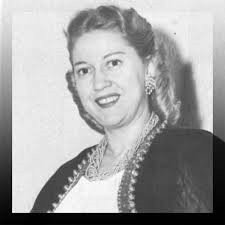
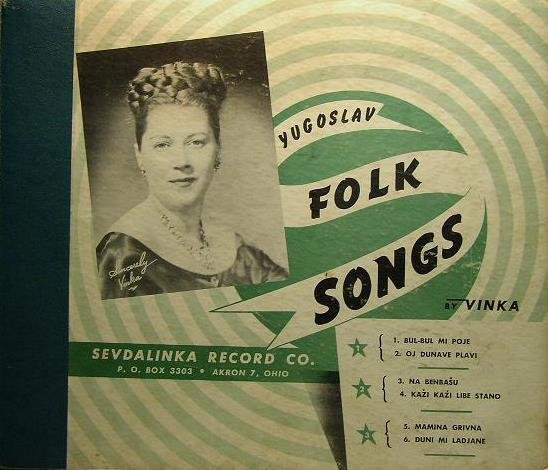
Vinka Ellesin was a folk singer who sang Serbian music in the sevdalinka style. The national Serbian community referred to her as the "Queen of Sevdalinka". She was born to Serbian immigrants, Djoka and Sophia (Soka) Ellesin, in Akron, Ohio around 1921. By the age of 16, she was singing on a nationally broadcast radio show on WADC. Later, she performed at the Black Whale, a well-known club in Cleveland. In 1938, the bandleader Sammy Kaye invited her to audition to be the lead vocalist in his orchestra, but she turned him down, preferring to continue singing Serbian folk music instead. During World War II, Ellesin performed at the Blue Danube and the Russian Samovar in Detroit, Mich. where she lived. Ellesin stayed in the Pittsburgh area for an extended period of time in the early 1950s while she performed nightly at the Sunrise Inn in Monroeville, Pa. During the 1930s through the 1970s, Ellesin toured throughout North America and Australia while returning to Pittsburgh many times to perform at local Serb National Federation events.
Ellesin was bestowed with many honors. She was inducted into the Tamburitza Hall of Fame in 1975. In 1977, she was honored with a testimonial dinner in Detroit that celebrated the golden anniversary of the beginning of her singing career. Ten years later, Congresswoman Helen Delich Bentley of Maryland honored Ellesin before the United States. Soon after, Bentley lobbied President Ronald Reagan to sign a letter of congratulations to Ellesin.
Ellesin married Pete Popvich sometime during the 1940s or 1950s. She owned Ventura Travel Service in Ventura, Ca. where she died in 1988. Her son, Alexis Ellesin, followed in her footsteps to become a business owner and a Serbian folk musician.
The Vinka Ellison Papers and Photographs primarily document Ellesin's singing career. There are many news clippings from Serbian newspapers, such as the American Srbobran, that reference her appearances and that summarize her professional career. Many of the articles are about her golden anniversary testimonial celebration held in Detroit in 1977. Three autograph albums, a souvenir program and photographs also document the testimonial dinner. Nine albums containing more news clippings and two folders of flyers, and programs further document her career. The correspondence includes letters of thanks and of best wishes, as well as the letter that notified her of her induction into the Tamburitza Hall of Fame. A photocopy of the letter of recognition from President Ronald Reagan is in the collection, as well. The photographs document her appearances, her personal life and her world travels to Spain, Canada, Yugoslavia, and other destinations. There are photographs of her parents, her family, her son, her friends and fellow performers, Other items in the collection include handwritten set lists, songbooks of other people's work, and her record album, Yugoslav Folk Songs. There is one oversize folder that contains a poster announcing a 1973 event in McKeesport, Pa. at which Vinka Ellesin appeared and additional songbooks.
Some of the newspaper clippings and much of the correspondence are written in Serbian or in the Cyrillic alphabet.
The Vinka Ellesin Papers and Photographs are in two archival boxes and arranged alphabetically by topic. The first box (1927-1987) contains the correspondence, newspaper clippings, photographs, three photograph albums and the record album. The second box (1939-1977) contains three autograph albums and nine albums containing newspaper clippings. The oversize folder contains the poster and the songbooks.
Source: Historic Pittsburgh