A great man is one who collects knowledge the way a bee collects honey and uses it to help people overcome the difficulties they endure - hunger, ignorance and disease!
- Nikola Tesla

Remember, remember always, that all of us, and you and I especially, are descended from immigrants and revolutionists.
- Franklin Roosevelt

While their territory has been devastated and their homes despoiled, the spirit of the Serbian people has not been broken.
- Woodrow Wilson

Vladimir Kulenović

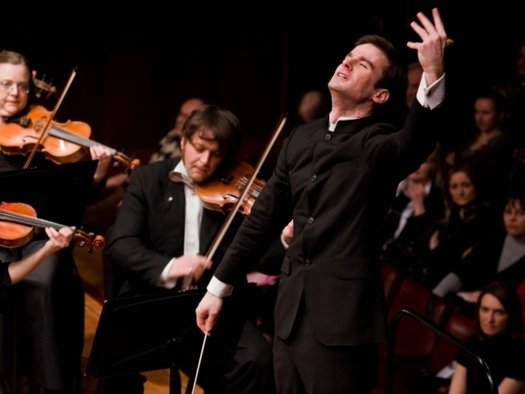
Following the completion of his post-graduate conducting studies at the Juilliard School, Vladimir Kulenovic was named Associate Conductor of Utah Symphony | Utah Opera in the U.S., Principal Conductor of the Kyoto International Music Festival in Japan and Resident Conductor of the Belgrade Philharmonic Orchestra in Serbia. His recent guest conducting engagements included collaborations with renowned orchestras in the US, Europe in Asia, as well as illustrious soloists including Leon Fleisher, Mischa Maisky, Akiko Suwanai, Joseph Silverstein and Augustin Hadelich, to name but a few.

This season in Europe, Kulenovic leads Leipzig Symphony, Belgrade Philharmonic, Slovenian Philharmonic, Zagreb Philharmonic and Macedonian Philharmonic. Following his debut in Asia at the Kyoto Music Festival, he led two critically acclaimed performances with Evergreen Symphony at the National Concert Hall in Taipei, and will return there in 2013/14. In the U.S., Kulenovic will conduct the final concert of the 2012/13 Utah Symphony subscription season in Abravanel Hall, make his debut with the Grand Rapids Symphony Orchestra in Michigan, and conduct the Jacksonville Symphony as one of 6 top emerging conductors chosen by the League of American Orchestras for the biannual Bruno Walter National Conducting Preview.

Recent engagements include performances with the Beethoven-Orchester Bonn at Beethovenhalle, Leipzig Symphony Orchestra, National Arts Centre Orchestra in Ottawa, Belgrade and Slovenian Philharmonic, Juilliard Orchestra at Lincoln Center, Deutsche Kammerakademie Neuss am Rhein, Verbier, Aspen, Salzburg Mozarteum and Cabrillo festival orchestras, and benefit a performance of Mozart’s Requiem with members of New York Choral Society and Juilliard Orchestra, which raised significant funds for Japan’s Disaster Relief Fund.

An alumnus of the Juilliard School, Kulenovic was awarded the Charles Schiff Conducting Prize for Excellence upon the completion of his post-graduate studies with James DePreist and Alan Gilbert. In addition to his formal studies, he continuously worked with Kurt Masur since 2008 in New York, Bonn, Leipzig and Verbier. As the Conducting Fellow at the Verbier Festival, Kulenovic conducted the Festival Orchestra in two internationally televised performances on Medici TV and was subsequently invited to serve as the conducting assistant to Kurt Masur at the Leipzig Gewandhaus Orchestra. In addition, Kulenovic also had the honor to prepare the orchestra at the Dubrovnik Festival for Zubin Mehta.

Recipient of the Sir Georg Solti Career Assistance Award, Mendelssohn-Bartholdy Scholarship, and Bruno Walter Memorial Scholarship, Kulenovic was the cover conductor of the Baltimore Symphony and Baltimore Opera and graduated from the Peabody Institute under the tutelage of Gustav Meier. He also served as a conducting fellow at the Aspen Music Festival, Salzburg Mozarteum and Cabrillo Festival of Contemporary Music.

Mr. Kulenovic was awarded the prestigious Alfred B. Whitney Prize for the Highest Scholastic Achievement at the Boston Conservatory, where he graduated summa cum laude as Valedictorian, earning degrees in Conducting and Piano Performance. As a pianist, Mr. Kulenovic won the 2nd Prize at the Rubinstein International Piano Competition in Paris.

From Official Web Site

Links:


SA


People Directory

Milorad Čavić

From Official website

Name: Milorad Čavić
Nickname: Mike, and Čavke
Birthday: 31 May 1984
Height: 6’6” (198cm)
Weight: 215 lbs (97kg)

University: University of California at Berkeley 2007
Major: Political Economics
Interests: Spending time with friends and family, movies, documentaries, nightlife, sports, animals, spear fishing, traveling.

Read more ...

Publishing

Holy Emperor Constantine and the Edict of Milan

by Bishop Athanasius (Yevtich)

In 2013 Christian world celebrates 1700 years since the day when the Providence of God spoke through the holy Emperor Constantine and freedom was given to the Christian faith. Commemorating the 1700 years since the Edict of Milan of 313, Sebastian Press of the Western American Diocese of the Serbian Orthodox Church published a book by Bishop Athanasius Yevtich, Holy Emperor Constantine and the Edict of Milan. The book has 72 pages and was translated by Popadija Aleksandra Petrovich. This excellent overview of the historical circumstances that lead to the conversion of the first Christian emperor and to the publication of a document that was called "Edict of Milan", was originally published in Serbian by the Brotherhood of St. Simeon the Myrrh-gusher, Vrnjci 2013. “The Edict of Milan” is calling on civil authorities everywhere to respect the right of believers to worship freely and to express their faith publicly.

The publication of this beautiful pocket-size, full-color, English-language book, has been compiled and designed by Bishop Athanasius Yevtich, a disciple of the great twentieth-century theologian Archimandrite Justin Popovich. Bishop Athanasius' thought combines adherence to the teachings of the Church Fathers with a vibrant faith, knowledge of history, and a profound experience of Christ in the Church.

In the conclusion of the book, the author states:"The era of St. Constantine and his mother St. Helena, marks the beginning of what history refers to as Roman, Christian Empire, which was named Byzantium only in recent times in the West. In fact, this was the conception of a Christian Europe. Christian Byzantine culture had a critical effect on Europe; Europe was its heir, and then consciously forgot it. Europe inherited many Byzantine treasures, but unfortunately, also robbed and plundered many others for its own treasuries and museums – not only during the Crusades, but during colonial rule in the Byzantine lands as well. We, the Orthodox Slavs, received a great heritage of the Orthodox Christian East from Byzantium. Primarily, Christ’s Gospel, His faith and His Church, and then, among other things, the Cyrillic alphabet, too."