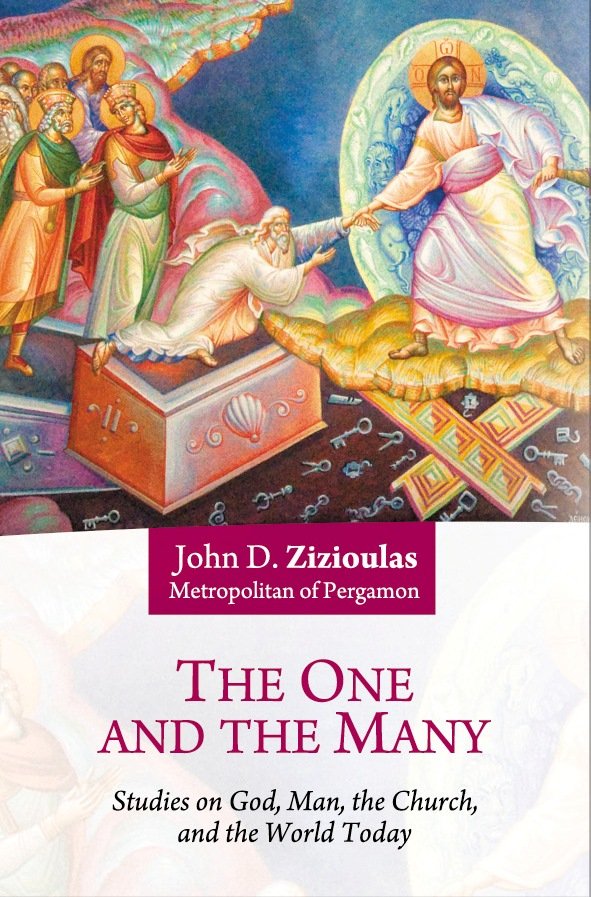
Studies of God, Man, the Church, and the World today
by Metropolitan John D. Zizioulas
This volume offers a collection of Zizioulas articles which have appeared mostly in English, and which present his trinianatarian doctrine of God, as well as his theological account of the Church as the place in which freedom and communion are actualized. The title, The One and the Many, suggests the idea of a profound relationship that exists between the Persons in the Holy Trinity, between Christ and the Church, between one Catholic Church and many catholic Churches. On each of these levels of communion, each one is called to receive from one another and indeed to receive one another. And while this is understandable at the Triadological and Christological levels, it raises all sorts of fundamental ecclesiological questions, since the highest point of unity in this context is both the mutual ecclesial-eucharistic recognition and agreement on doctrine and canonical-eccelesiological organization.
The book has the Preface written by Bishop Athanasius Yevtich, and an extensive and valuable Introduction (pp. xi-xxi) written by Paul Mc Partlan. Part one contains Zizioulas STUDIES IN TRIADOLOGY (Trinitarian theology): The Doctrine of God the Trinity Today (pp. 3-16: The need for a fresh study; The question of God s being in relation to the world; The problem of God s being in Himself; The place of Trinitarian theology in Ecclesiology; Conclusion). The Being of God and the Being of Man (pp. 17-40: The need for a serious theological dialogue; A controversial issue: Trinitarian theology and the human person; Personalism-Existentialism and the theological concept of the person; Neoplatonism and patristic theology; Apophaticism and ontology; The personal existence of God and the human person; The importance of Christology and history; The eschatological character of salvation; Conclusion). This parts ends with an article One Single Source: An Orthodox Response to the Clarification on the Filioque (pp. 41-45). Part Two: STUDIES IN ECCLESIOLOGY: The Church as Communion (pp. 49-60: Introduction; Koinonia as a theological concept; The Church as koinonia ; Conclusion). Ecclesiological Presuppositions of the Holy Eucharist (pp. 61-74: Historical background; The Eucharist makes the Church and the Church constitutes the Eucharist; Conclusions; Our ecumenical situation today). The Pneumatological Dimension of the Church(p.75-90: The place of Pneumatology in ecclesiology; Pneumatology and the actual structure and life of the Church). Some Reflections on Baptism, Confirmation, and Eucharist (p.91-). Symbolism and Realism in Orthodox Worship (pp. 101-117: Introduction; The notion of symbol; Symbolism in the Christian Faith; Symbolism in Orthodox worship; Iconic symbolism in worship; A look at the situation today). The Theological Problem of Reception (pp. 118-125: Introduction; The classical idea of reception and its theological significance; The actual ecumenical situation); Eschatology and History (pp. 126-135); The Mystery of the Church in Orthodox Tradition (pp. 136-146: Some basic theological presuppositions; The importance of these principles for ecclesiology); The Early Christian Community (pp. 147-169: Primitive Christianity; Aspects of the Faith of the early Christian community; The early Patristic period; The challenge of Gnosticism; The emergence of a Christian Gnosticism; Martyrdom as a form of spirituality; Toward medieval spirituality); Preliminary Considerations on the Concept of Authority (pp. 170-176); The Meaning of Ordination (pp. 177-180); Ordination and Communion (pp. 181-189: Some preliminary considerations; Ordination in the light of communion; Some concluding remarks); The Development of Conciliar Structures to the Time of the First Ecumenical Council (pp. 190-213: Primitive conciliarity on the local level; The transition to provincial conciliar structure; Toward an Ecumenical Council; Some concluding remarks); Comment on Communal Spirit and Conciliarity (pp. 214-220).
ISBN: 978-0-9719505-4-2