by Fionn Zarubica
The clothes we wear today are very different from the clothes we wore 2000 years ago; but, in the Christian Orthodox church, the clothes the priests wear are almost exactly the same. These clothes are called vestments. The word vestment comes from the Latin word vestis, which means garment.
During the time of the Apostles, when the Christian church was being established, there was no difference between the clothes worn for everyday life and the clothes worn for celebration of the sacraments. This was not only because formal vestments had not been established, but also because during that time, Christians were being persecuted and did not wish to draw attention to themselves.
In the fourth century, Constantine the Great fought and won a major battle at the Milvian Bridge, became the first Christian Roman Emperor and established Constantinople, the “New Rome” at Byzantium. Under his rule Christians were able to practice their faith openly, and the church fathers began to call for a formal manner of dress for clergy in service to the church.
What we consider today as traditional clergy dress is based on Roman dress of the 3rd and 4th century, although some time elapsed before the everyday garment of that time came to be regarded without any doubt as a liturgical vestment, worn specially for the celebration of the liturgy. Over time the dress of ordinary life changed, and there emerged a noticeable difference between the dress of the clergy and the people. Monastic orders were different from them both.
When Justinian I became Emperor, in 527 CE, liturgical vestments, particularly those of the bishops, began to imitate the dress of the Emperor’s court. Silks were used to make the finest vestments. Until that time, silk was imported from Sogdiana in Central Asia and the Sassanian Empire in Persia. But Persia was a chief enemy of the Byzantine Empire, and supplies of silk were always in peril. Because silk was such a valuable article of trade, this was of great concern to Justinian. It is said that one day two monks came to Justinian by way of India, and offered to provide him with the eggs of the silkworm. They also offered to teach his people to produce their own silk, a process called sericulture. Seeing that he would never have to be dependent on his enemies the Persians again, Justinian accepted the Monks’ offer and thus silk production was established in the Byzantine Empire. The Byzantine Empire became famous and wealthy because of its silks, and the churches were well supplied with materials for their vestments.
The Byzantines were not only famous for their silks, but for their embroideries as well. They were most renowned for their technique with gold embroidery, which they preferred over colored thread embroidery. It is said that they were masters at releasing the fire from within the gold when lit by church candles. Thanks to the support of Justinian I, Constantinople became a center for the textile arts for the next 900 years.
It is not only in the vestments that we see special textiles for the church. Woven and decorated textiles were highly prized. Silks with Christian scenes were in great demand as wall hangings, coverings for the holy table, holy relics, and other sacred elements; as well as the veil used to decorate the sanctuary and the curtain for the door of the iconostasis, which was used to shield the altar from public gaze during the most sacred moments in the liturgy.
Although the vestments of the Orthodox Church have their origins in the ordinary, they have become something quite extraordinary. Practical garments and precious works of art, everyday clothing and symbols of devotion. Their beauty reflects heaven on earth; each thread a prayer that unites us with one another across all boundaries of space and time.
Love is all that matters!
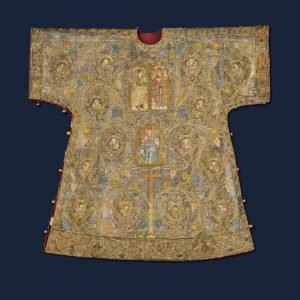
Image:
Sakkos of the Bishop of Melenikon Ioannikios
Date: 18th century
Medium: Silk, linen, gold and silver
Accession Number: ΒΥΦ 58
Museum of Byzantine Culture, Thessaloniki, Greece
Source: Heal To Be - a blog about personal culture