A great man is one who collects knowledge the way a bee collects honey and uses it to help people overcome the difficulties they endure - hunger, ignorance and disease!
- Nikola Tesla

Remember, remember always, that all of us, and you and I especially, are descended from immigrants and revolutionists.
- Franklin Roosevelt

While their territory has been devastated and their homes despoiled, the spirit of the Serbian people has not been broken.
- Woodrow Wilson

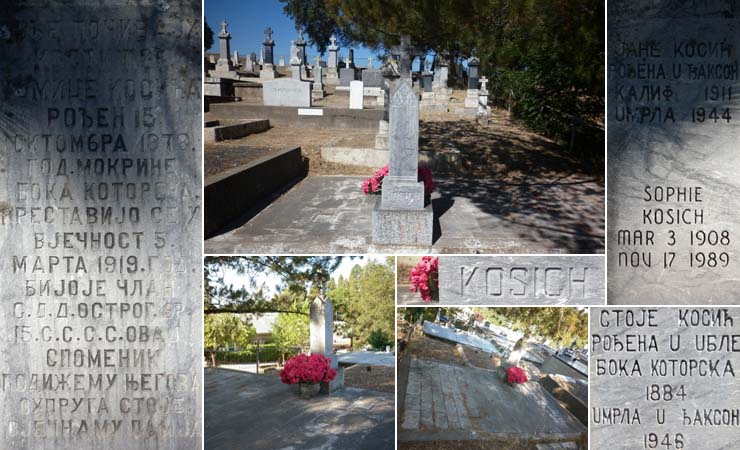
Tomica 1878 - 1919, Stoje 1884 - 1946, Jane 1911 - 1944, Sophie 1908 - 1989

Предња страна споменика:

ОВЂЕ ПОЧИВАЈУ

   КОСТИ ПОК.

ТОМИЦЕ КОСИКА

    РОЂЕН 15.

ОКТОМБРА 1878.

ГОД. МОКРИНЕ

БОКА КОТОРСКА

ПРЕСТАВИЈОСЕ У

   ВЈЕЧНОСТ 5.

МАРТА 1919. ГОД.

 БИЈОЈЕ ЧЛАН

С. Д. Д. ОСТРОГ. БР.

15  С. С. С. С. ОВАЈ

    СПОМЕНИК

ПОДИЖЕ ЊЕГОВА

СУПРУГА СТОЈЕ.

ВЈЕЧНАМУ ПАМЈАТ. 


Бочна лева страна споменика:

  СТОЈЕ КОСИЋ

РОЂЕНА U UБЛЕ

БОКА КОТОРСКА

           1884

УМРЛА У ЂАКСОН

          1946


Бочна десна страна споменика:


      ЈАНЕ КОСИЋ

РОЂЕНА У ЂАКСОН

     КАЛИФ. 1911

    УМРЛА 1944


      SOPHIE

      KOSICH

    WAR 3 1908

   NOV 17 1989


SA


People Directory

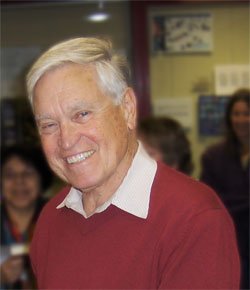
Dragoslav D. Šiljak

Dragoslav D. Šiljak (born 1933 in Belgrade, Serbia) is a professor of Electrical Engineering at Santa Clara University, where he holds the title of Benjamin and Mae Swig University Professor. He received the Ph.D. degree in Electrical Engineering in 1963 from the University of Belgrade.

He is the author of the book 'Decentralized Control of Complex Systems', Academic Press (1991).

.
Read more ...

Publishing

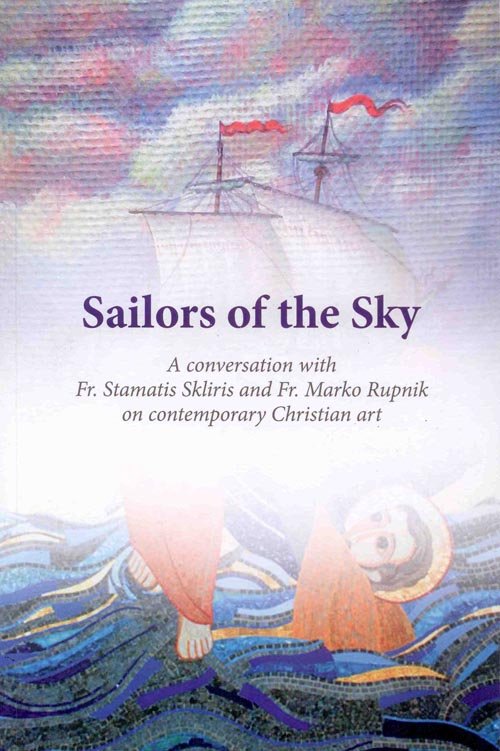
Sailors of the Sky

A conversation with Fr. Stamatis Skliris and Fr. Marko Rupnik on contemporary Christian art

In these timely conversations led by Fr. Radovan Bigovic, many issues are introduced that enable the contemporary reader to deepen and expand his or her understanding of the role of art in the life of the Church. Here we find answers to questions on the crisis of contemporary ecclesiastical art in West and East; the impact of Impressionism, Expressionism, Cubism, Surrealism and Abstract painting on contemporary ecclesiastical painting; and a consideration of the main distrinction between iconography and secular painting. The dialogue, while resolving some doubts about the difference between iconography, religious painting, and painting in general, reconciles the requirement to obey inconographic canons with the freedom essential to artistic creativity, demonstrating that obedience to the canons is not a threat to the vitatlity of iconography. Both artists illumine the role of prayer and ascetisicm in the art of iconography. They also mention curcial differences between iconography in the Orthodox Church and in Roman Catholicism. How important thse distinctions are when exploring the relationship between contemporary theology and art! In a time when postmodern "metaphysics' revitalizes every concept, these masters still believe that, to some extent, Post-Modernism adds to the revitatiztion of Christian art, stimulating questions about "artistic inspiration" and the essential asethetic categories of Christian painting. Their exceptionally wide, yet nonetheless deep, expertise assists their not-so-everday connections between theology, ar, and modern issues concerning society: "society" taken in its broader meaning as "civilization." Finally, the entire artistic project of Stamatis and Rupnik has important ecumenical implications that aswer a genuine longing for unity in the Christian word.

The text of this 94-page soft-bound book has been translated from the Serbian by Ivana Jakovljevic, Fr. Gregory Edwards, and Andrijana Krstic. Published by Sebastian Press, Western American Diocese of the Serbian Orthodox Church, Contemporary Christian Thought Series, number 7, First Edition, ISBN: 978-0-9719505-8-0